i.
The sponsor signed the protocol. The sponsor owns the data. No master service agreement transfers regulatory accountability.
Lauren Alani helps biotechnology and pharmaceutical sponsors safeguard clinical data integrity across the full trial architecture, at the layer where sponsor intent meets vendor execution.

Featured In
As Seen In

The industry has become highly sophisticated in individual functions: data management, clinical operations, technology procurement, regulatory affairs. But these functions operate in isolation.
Not the sponsor, not the CRO, not the vendor currently sees the data as a red line through every system, every vendor, and every regulatory checkpoint. That absence of an end-to-end perspective is where risk accumulates, silently, until it surfaces as an inspection finding, a submission delay, or an asset valuation question that nobody saw coming.
Aligned to ICH GCP E6(R3), EMA guidelines, and FDA 21 CFR Part 11. Chair of the ACDM eDigital Data Management Expert Group, 2019-2024. Co-author of four ACDM industry whitepapers. Ongoing collaborator with the Digital Medicine Society.
The structural patterns Lauren returns to in writing, speaking, and advisory engagements with biotechnology and pharmaceutical sponsors.
The sponsor signed the protocol. The sponsor owns the data. No master service agreement transfers regulatory accountability.
The regulator-vendor gap is structural, not accidental. Sponsors absorb it whether or not they recognise it as a gap.
Define trial-level requirements before selecting clinical technology. Selection without specification is a procurement risk.
Data integrity is enterprise risk that touches asset valuation directly, not regulatory hygiene at submission time.
You can delegate tasks. You cannot delegate responsibility.
Read more →Regulators set expectations vendors are not directly accountable for. Sponsors absorb the gap.
Read more →Define trial-level requirements before selecting clinical technology.
Read more →Compliance protects asset value, investor confidence, and long-term success.
Read more →Common questions from journalists, podcast hosts, conference programmers, and biotech sponsors considering Lauren for a stage, a story, or a strategic conversation.
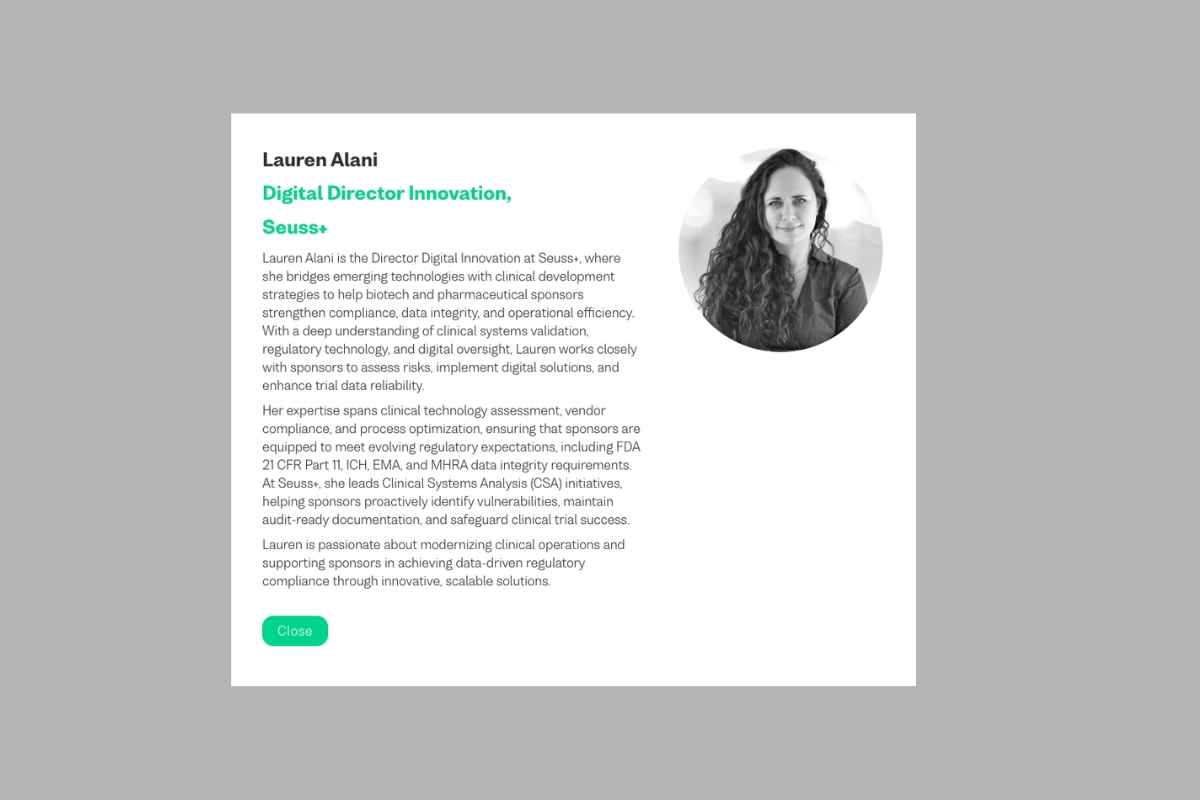
Lauren Alani is Director of Digital Innovation at Seuss+, a life sciences consultancy supporting biotechnology and pharmaceutical sponsors across clinical development. She helps sponsors safeguard clinical data integrity across the full trial architecture, at the layer where sponsor intent meets vendor execution. Lauren chaired the ACDM eDigital Data Management Expert Group from 2019 to 2024 and continues to collaborate with the Digital Medicine Society. She is UK-based and works with sponsors globally.
Lauren writes and speaks on clinical systems governance, sponsor accountability, computerised system validation, vendor oversight, electronic data flow, inspection readiness, and the regulatory shift sponsors are navigating under ICH GCP E6(R3), EMA guidelines, and FDA 21 CFR Part 11. She brings the ecosystem perspective: no single party (sponsor, CRO, or vendor) currently owns the full data journey, yet the sponsor remains accountable for it.
Lauren’s perspectives organise into four topics. First, Accountability Cannot Be Delegated: master service agreements transfer the work, not regulatory accountability. Second, The Regulator-Vendor Gap: regulators set expectations vendors are not directly accountable for. Third, Requirements Before Selection: define trial-level requirements before selecting clinical technology. Fourth, Data Integrity Is a Commercial Risk: ALCOA+ is the regulatory floor; asset defensibility is the commercial ceiling.
Use the booking form on the Media page, or email Gina Dunn, Director of Marketing at Seuss+, at g.dunn@consultseuss.com. Lauren takes podcast appearances, conference keynotes, panels, regulatory roundtables, and press interviews. ARKFest 2026 is a confirmed return engagement; she is currently accepting Q2 2026 speaking invitations.
CEOs, founders, and leadership teams at clinical-stage biotech (typically 2-200 employees, Phase 1-2). Heads of clinical operations, data management, and quality at biotech and pharmaceutical sponsors. CTOs and IT leads evaluating clinical systems. Investors conducting due diligence on clinical-stage assets. Secondary audiences include CRO leadership, clinical technology vendors, biotech advisors, and life sciences media.
The ecosystem perspective treats clinical trial data as a single red line that runs through every system, every vendor, and every regulatory checkpoint, rather than as a series of function-by-function handoffs. The industry has become highly sophisticated within individual functions (data management, clinical operations, technology procurement, regulatory affairs) but those functions operate in isolation. The absence of an end-to-end view is where risk accumulates silently, until inspection, submission, or asset valuation surfaces it.